Built for zinc rolling
The engine was built by the C&G Cooper Company of Mount Vernon, Ohio, for the Matthiesen-Hegeler Zinc Company in LaSalle, Illinois. It was operating there by 1914, driving a bank of zinc rolling mills and a line shaft that powered other equipment. A club brochure notes that rolled zinc from the plant was used for many products, including battery cases.
Saved and moved to Freeport
In 1980, a club member learned that the old steam engines at the zinc works were destined to be scrapped. On March 22, a group of 14 club members visited the plant. Then-club president Joe Maurer described what they found as an industrial archaeological find, with tools, clipboards and calendars still in place.
Fred and Cynthia Carus donated the Cooper engine to the Stephenson County Antique Engine Club in 1981. Club members dismantled it piece by piece and moved it to Freeport with donated labor and trucking. A club brochure says the work took well over a year. The parts remained in storage until the club acquired the former Stephenson County Nursing Home building that now houses the museum.
A foundation for 130 tons
Behind the museum, the club built a substantial foundation for the engine. Seven vertical holes, each 25 feet deep and two feet in diameter, were drilled and filled with reinforced concrete. The base used nearly 100 yards of concrete and about 4,000 feet of one-inch reinforcing steel. The original page records the foundation cost as $16,000.
Reassembly and operation
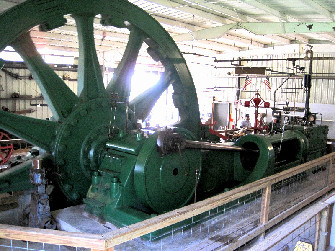
The engine was reassembled by club volunteers in 1989. Its 25-foot, 4-inch flywheel is made of twelve sections weighing about five tons each. The sections are joined by 24 three-inch-diameter bolts and 96 dog-bone-shaped keys measuring 2.5 inches square by 30 inches long. The flywheel is supported by a crankshaft weighing about 25 tons, and the original page says final assembly required 12 hours.
In 1990, a 60-by-60-foot metal building was constructed over the engine at a cost of $30,000. The club located a used gas-fired boiler in 1991 and installed it with the engine. On July 13, 1991, the Cooper was test-run at six revolutions per minute; a later club brochure records about 40 visitors watching its first run in its new home. The engine is capable of 45 RPM. In 1992, painting the engine required 16 gallons of paint.
Cooper specifications
- Total engine weight: 130 tons
- Flywheel: 25 feet, 4 inches in diameter; 60 tons
- Crankshaft: about 25.5 tons
- Connecting rod: 2,350 pounds
- Concrete base: about 200 tons
- Cylinder bore: 32 inches
- Stroke: 62 inches
- Rated output: 4,798 horsepower at 45 RPM and 225 psi steam
- Average torque at the hub: about 250,000 foot-pounds
The club's original page describes the engine as the largest flywheel steam engine within 500 miles of Freeport.